


Legal Rights and Remedies for Trucking Accident Victims in Los Angeles and West Covina
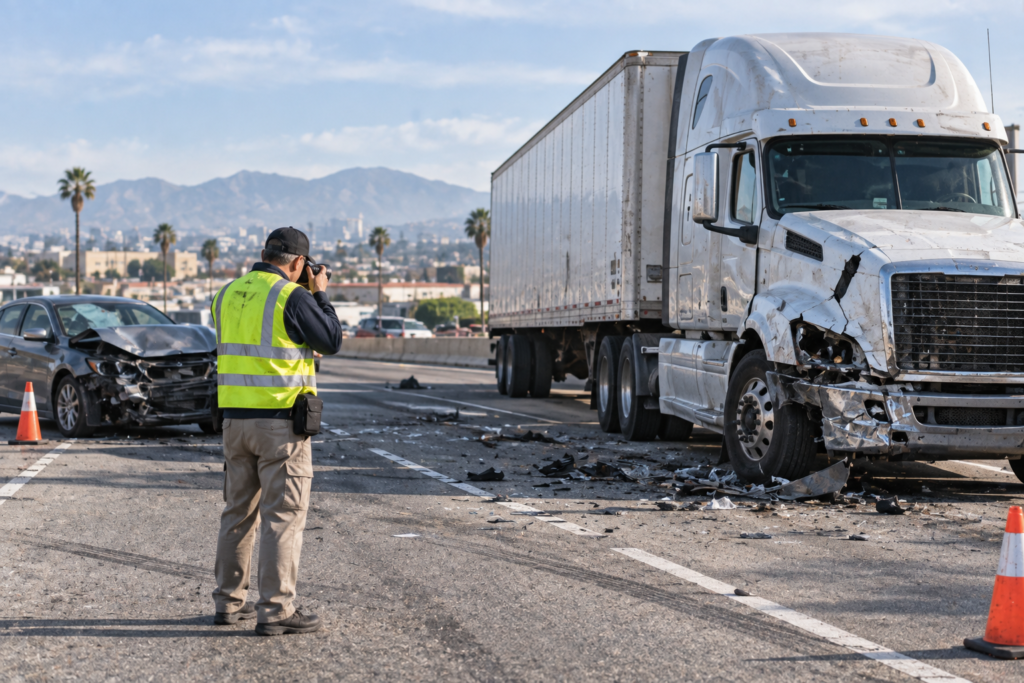
People injured in a trucking accident may have claims that look similar to an ordinary car-accident case at first but become more complicated once the investigation begins. A commercial truck crash can involve the driver, motor carrier, vehicle owner, maintenance provider, cargo interests, broker, manufacturer, or another party depending on the facts.
The injured person’s basic rights remain straightforward: obtain medical care, preserve evidence, identify potentially responsible parties and insurance, and pursue compensation when another person or business caused the harm. The challenge is determining which evidence and legal duties apply to the particular trucking operation.
More Than One Party May Be Responsible
A truck driver may cause a crash through unsafe speed, fatigue, distraction, an unsafe lane change, following too closely, impairment, or another negligent act. The driver’s employer or motor carrier may also become relevant depending on employment, dispatch, maintenance, training, hiring, supervision, ownership, and other facts.
Other cases may involve a separate maintenance contractor, defective component, improperly secured cargo, trailer owner, or another business. The goal is not to name every entity associated with the truck. It is to identify which parties actually had a legal role in causing the collision.
Federal Safety Rules Can Matter
Many interstate commercial motor carriers and drivers are regulated by the Federal Motor Carrier Safety Administration. Federal rules address issues such as driver qualifications, hours of service, inspection, maintenance, and recordkeeping.
For property-carrying drivers subject to the standard federal hours-of-service rules, FMCSA currently allows a maximum of 11 hours of driving after 10 consecutive hours off duty and generally prohibits driving beyond the 14th consecutive hour after coming on duty. A 30-minute break is also generally required after eight cumulative hours of driving without a qualifying interruption, subject to the rules and exceptions.
Those limits do not prove fatigue in every crash, and a violation does not automatically establish every element of a civil claim. But driver logs, electronic logging device data, dispatch records, and work schedules can become important when fatigue or excessive driving time is genuinely at issue.
Truck Evidence Can Disappear or Change Quickly
Commercial trucking generates records that may not exist in an ordinary passenger-car case. Depending on the collision, useful evidence can include electronic logging data, driver qualification files, dispatch communications, inspection records, maintenance history, onboard electronic data, dash-camera footage, bills of lading, cargo records, repair records, and post-crash testing information.
The physical truck and trailer can also change after a crash. Repairs begin, components are replaced, cargo is unloaded, and electronic systems may overwrite data. Early preservation requests can therefore matter.
The article on what makes a good semi-truck accident lawyer discusses why trucking evidence and federal safety rules require a more focused investigation than a generic car-accident claim.
Accident Reconstruction May Help in Disputed Cases
Large trucks have different weight, braking, turning, and visibility characteristics from passenger vehicles. A reconstruction expert may be useful when the parties dispute vehicle movement, speed, impact location, stopping distance, visibility, or the sequence of a multi-vehicle collision.
The article on the role of accident reconstruction experts in legal cases explains how physical evidence, measurements, electronic data, and engineering analysis can help evaluate competing descriptions of an accident.
Insurance Coverage Can Be More Complex
Commercial trucking cases can involve multiple policies and insured parties. Coverage questions may depend on who owned the tractor and trailer, whether the driver was operating for a motor carrier, lease arrangements, employment status, and the specific policies in force.
The existence of commercial insurance does not guarantee that every claimed loss will be accepted. Insurers may dispute fault, causation, medical treatment, the amount of damages, or whether a particular policy applies.
Medical Evidence Still Drives the Injury Claim
Even when liability evidence is strong, a claimant must still document the injuries and resulting losses. Truck crashes can cause fractures, head injuries, spinal injuries, internal injuries, burns, and other serious harm, but the legal claim should be based on the injuries that actually occurred.
Prompt and appropriate treatment can help document the medical timeline. The article on the importance of prompt medical treatment after an accident explains why delayed or inconsistent documentation can complicate an otherwise valid injury claim.
Damages May Include Economic and Non-Economic Losses
Depending on the evidence, damages can include reasonable medical expenses, future care, lost earnings, reduced earning capacity, property damage, pain, suffering, emotional distress, physical impairment, disfigurement, and other compensable losses caused by the collision.
A serious injury can also affect household responsibilities, mobility, recreation, and long-term employment. Future losses should be supported by medical, vocational, economic, or other qualified evidence rather than a generic estimate.
Comparative Fault Can Affect Recovery
California follows comparative-fault principles. A truck driver or motor carrier is not automatically responsible simply because a commercial vehicle was involved. The conduct of every relevant road user may be considered.
If an injured person is found partly responsible, the recoverable damages can be reduced according to that percentage of fault. Evidence of lane position, speed, following distance, traffic controls, video, witness accounts, and vehicle data can become important when responsibility is disputed.
Truck Accident Claims in West Covina and Los Angeles County
For a truck crash in West Covina, the San Gabriel Valley, or elsewhere in Los Angeles County, the early investigation should identify the carrier, driver, tractor, trailer, insurance, witnesses, available video, and records that may disappear with time.
A trucking accident claim should not be treated as automatically stronger because a commercial vehicle was involved. The strength of the case comes from proving who violated a legal duty, how that conduct caused the crash, what injuries resulted, and what compensation is supported by the evidence.
