


Motorcycle Injury by Drunk Driver
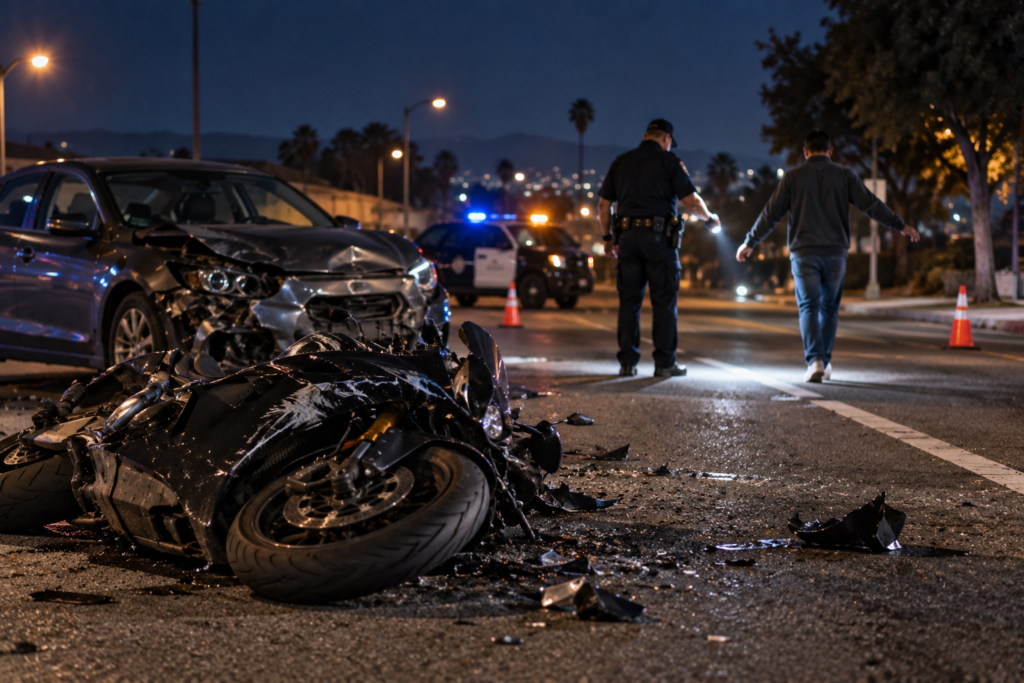
A motorcyclist injured by a drunk driver can have a civil personal injury claim even while the driver faces a separate criminal DUI case. The two proceedings serve different purposes. The criminal case addresses whether the state can prove a violation of California’s DUI laws. The civil claim focuses on responsibility for the collision and compensation for the injuries and losses caused by it.
Alcohol impairment can be powerful evidence, but it does not eliminate the need to prove how the crash happened. A claimant still needs evidence connecting the impaired driver’s conduct to the collision and documenting the resulting injuries.
California Prohibits Driving Under the Influence
California Vehicle Code section 23152 makes it unlawful to drive while under the influence of an alcoholic beverage. It also prohibits driving with a blood-alcohol concentration of 0.08 percent or more, subject to the statute and evidentiary rules.
A DUI arrest or conviction can be important evidence in a civil case, but a personal injury claim should not be reduced to the criminal charge alone. The collision evidence still matters: vehicle positions, speed, lane movement, traffic controls, witness statements, video, braking, and the sequence of impact.
The Criminal DUI Case and Civil Injury Claim Are Separate
The prosecutor controls the criminal case. The injured rider does not decide what charge is filed, whether a plea is offered, or what sentence is imposed. A civil claim is pursued by or on behalf of the injured person and seeks compensation for legally recoverable losses.
The burden of proof also differs. A criminal conviction generally requires proof beyond a reasonable doubt. A civil personal injury case uses a different standard and focuses on negligence, causation, and damages.
A criminal case can create useful records, but an injured motorcyclist should not assume that waiting for the prosecution to finish will preserve every piece of civil evidence or every legal deadline.
Preserve Evidence of Impairment and the Collision
Potentially useful evidence can include the traffic-collision report, body-camera or dash-camera footage when available, witness statements, photographs, surveillance video, field-sobriety observations, chemical-test information, vehicle damage, and records from the criminal proceeding.
Some material may require formal requests, subpoenas, or litigation procedures before it can be obtained. Other evidence, such as private surveillance footage, may disappear quickly unless someone acts to preserve it.
Motorcycle Crash Evidence Still Matters
Motorcycles are smaller and less protective than passenger vehicles, so the resulting injuries can be severe. But severity does not determine fault. Investigators still need to determine whether the driver crossed the centerline, turned across the motorcycle’s path, changed lanes unsafely, rear-ended the rider, ran a signal, or caused the collision in another way.
The article on common causes of motorcycle accidents in California explains how visibility, intersections, lane changes, speed, road conditions, and rider conduct can affect the liability analysis.
Comparative Fault Can Still Be Raised
An impaired driver can still argue that the motorcyclist contributed to the accident. California comparative-fault principles allow responsibility to be divided when more than one person’s conduct contributed to an injury.
That means evidence of the rider’s speed, lane position, signals, lighting, helmet use where relevant to injury issues, and other conduct may become part of the case. Impairment can be highly significant without automatically resolving every disputed fact.
Punitive Damages Are Not Automatic
California law allows punitive damages in certain civil cases when the required standard for oppression, fraud, or malice is met. A drunk-driving collision may raise a punitive-damages issue depending on the evidence, but punitive damages are not automatic simply because alcohol was involved or because a DUI charge was filed.
The evidence and legal standard must be evaluated in the particular case. Compensatory damages for medical expenses, lost income, pain, suffering, and other losses are analyzed separately.
Insurance Still Needs to Be Investigated
The impaired driver’s liability insurance may be one source of recovery. When the driver has no insurance or not enough insurance, the injured rider’s uninsured or underinsured motorist coverage may become important if applicable.
Policy limits, exclusions, ownership, permissive use, multiple injured claimants, and other coverage issues can affect the amount available. A criminal conviction does not increase an insurance policy’s contractual limit.
Serious Motorcycle Injuries Require Strong Medical Documentation
Motorcycle crashes can cause fractures, traumatic brain injuries, spinal injuries, burns, road rash, internal injuries, and permanent impairment. Medical care should be driven by the rider’s actual condition, not by the existence of a DUI case.
The article on prompt medical treatment after an accident explains why accurate treatment records and consistent follow-up can help establish the connection between the crash and the injuries.
If a rider suffers a head injury, the guide on understanding brain injuries after an accident discusses delayed symptoms, medical documentation, and functional impact.
Damages Depend on the Actual Losses
A valid claim can include reasonable medical expenses, future treatment, lost earnings, reduced earning capacity, pain, emotional distress, disfigurement, physical impairment, property damage, and other losses caused by the collision.
Motorcycle cases can also involve damage to riding gear, electronics, and the motorcycle itself. Evidence should distinguish property loss from bodily injury and document each category rather than relying on estimates.
Drunk-Driving Motorcycle Accidents in West Covina
For a motorcycle collision involving suspected drunk driving in West Covina, the San Gabriel Valley, or Los Angeles County, early investigation can preserve both ordinary crash evidence and evidence related to impairment.
The DUI charge may become an important part of the case, but the civil claim still needs to answer the fundamental questions: how did the collision occur, who caused it, what injuries resulted, what insurance applies, and what damages can be proven?
